Free Inquiry Project Feb 1-7 Update

This week marked the third week since the beginning of the semester that I have been following my training plan as laid out last week. This week’s training was useful as a data point on how my body is responding to the combination of climbing and strength training, as it showed little numbers wise, but I could feel changes.

Climbing Progress

I completed my two sessions this week focusing mostly on bouldering, but I did climb a top rope 5.10a on Thursday. During both sessions I was able to complete multiple V4 boulders, aligning with my baseline, and confirming that even with the strength training I am able to maintain my climbing level. Notably, I was able to make significant progress on a V5 boulder problem, but was limited by my finger strength, something that I will get to later in the weights section.

During my top rope climbing session I found that arms were getting much more sore than when I bouldered, it is a much higher volume of climbing. I was not able to flash the route unfortunately, as I had to take a couple breaks in between attempts. However, this is good progress towards my goal.

I believe that to be able to climb a higher grade, my strength is improving at a decent enough pace, however I will need to work more on my technique.

Strength Training

I completed my strength training this week focusing on volume rather than going for heavier weights, as I have been advised.

My program looks like:

  • Squat: 10×3 – 155lbs
  • Bench Press: 10×3 – 115lbs
  • Deadlift: 5×6 – 245lbs

The weights this week were conservative, but the higher volume still made the session challenging. As my fingers were sore from my V5 attempt the previous day, I found myself slipping during my deadlifts, and my fingers were really the limiting factor rather than back or legs.
From a performance perspective, all of the lifts were fine, and I didn’t experience any signs of injury, just the soreness of the climbing meant that I could not do more. Next week I will have to focus on rest and recovery, or focus on creating a healthy training program for my fingers.

This is a video of me doing a set of squats.

Reflection

The key takeaway this week was fatigue and performance. I have not seen any large gains, but I did not regress, which is a fantastic outcome during the early stages of this program. The combination of both climbing and strength training is quite demanding, and my body certainly felt it. However, after the first week where I was doing this, where i set my baseline, I was barely able to walk and last week I was mostly able to function as normal. The only exception to this has been my fingers, which have been struggling to recover between a climb than a lift. Perhaps using wraps or chalk will help me for this problem, I will do a test this week.
Topic 5 – Weekly Reflection Blog Post

This week there was no prompt given for reflection, so I will be talking about my experience at the Pacific School Of Innovation and Inquiry (PSII).

Inquiry Based Learning

PSII’s style of learning is based around the student with inquiry being at the core of their process. Students engage with questions about something that is close to them, that brings out their own curiosity, and then they are directed to research that topic. More about the process can be found here or in this youtube video: https://www.youtube.com/watch?v=QlwkerwaV2E

Pros

I think that the inquiry based model of learning is a fantastic model for some students, as it provides a frankly dramatically different model than conventional schooling. In my opinion, the students that benefit from this model the most can be broken down into two types of student: the overachievers, and the disinterested.

Personally, I know several students that went to PSII who have advanced degrees, largely spurred by the inquiry that they did at PSII. Before PSII they were also always overachievers, scholarship students and straight A students, but at PSII they were able to flourish and create fantastic inquiry projects, such as a full novel. The inquiry process allows them to not be hindered by traditional classrooms and keeps pushing the students further and further.

On the other hand, the classically disinterested students also found a place at PSII. Friends of mine that went to PSII that were generally considered “problem children” or “too energetic” and “hard to contain” were able to find their niche at school, and apply their energy to something that actually grabbed their attention.

Cons

Nothing is perfect however, PSII’s model does not fit for everyone. Unfortunately, a big problem for PSII’s model is that it requires a lot more individual support and attention, which means that the classic ratios of students to teachers needs to be a lot higher. I believe that the current numbers roughly work out to a ratio of 1:12 teachers to students, which is a significantly lower number than the usual public numbers. Another problem is drive and motivation. If students are not interested in schooling in general it can be hard, even with an inquiry based model, to fully engage those students in education, and having a school where there is the ability to do functionally nothing all day means that you will get some students who take that opportunity. The traditional schooling model provides checks and if you are not doing work all day, by virtue of being in classes it is easier for teachers to check in and catch those students.

Free Inquiry Introduction

For my free inquiry this semester I have planned to track my climbing performance and my workout performance and describe my journey through both.

Introduction

I chose this topic as I have been climbing for a long time, but have plateaued at a certain difficulty of climb, specifically V4 for bouldering (my main kind of climbing). I wanted to improve my climbing, and so I reached out to a friend who is a PHD candidate in Strength and Conditioning, and a professional strength coach for Canadian national teams. He advised me on several types of workouts that I could do to improve my climbing performance. So, my main goals for this semester are to “send” a V6 & a 5.10C climb, lift 750lbs between squat, bench press, and deadlift, and to lose 10 pounds. This is an ambitious goal, but I believe that I will be able to achieve it if I keep to my schedule.

My Starting Stats

Climbing: I have been climbing much more frequently than working out, so I am able to flash V4 boulders and 5.10a top rope climbs.

Gym Stats: I have been advised to not try and hit my maximum right at the beginning, as that could lead to injury and so I have recorded my baseline.

  • Squat: 5x185lbs
  • Bench Press: 5x135lbs
  • Deadlift: 5x275lbs

Total: 600lbs

The Routine

For the routine I have decided on going climbing twice a week and strength training twice a week. This lets me balance my school work, social life, as well as providing workable amounts of time for achieving my goals.

Climbing: I plan on climbing twice a week minimum, with Tuesday and Thursday being my dedicated climbing days. There is also the option of adding Saturday as a climbing day, depending on school workload and soreness. I plan on climbing for 1.5 hours each session, with Tuesday dedicated to bouldering and Thursday doing a mix of bouldering and top rope climbing. Saturdays would be a more social climb, and so would be 2-2.5 hours depending.

Gym: For the gym, I will go on Wednesdays and Fridays, as I have no class Wednesday and Friday I have no class in the afternoon. Both sessions will take roughly 1.5 hours as well, Wednesday I will do a mix of exercises, but will start with Squats, Bench Press, and Deadlifts which are the trackers I am using. Friday I will do a mix of lower weight exercises, including biking for my cardio and weight loss, and core exercises.

Ed Tech Elements

As a part of this assignment, I will also start to film myself in attempts on harder boulder problems as well as a weekly video of one type of lift. These videos serve two purposes: First, to observe myself and to help me adjust form, and technique & Second, to keep myself accountable to posting once a week.

Additionally, I will be taking my friend’s professional advice for what lifts and exercises to do, and post any new exercises to the blog, detailing why I have added them to my routine. Below are a few videos, one detailing the basics of bouldering, and one detailing the basic form for the lifts I will be doing to begin. Personally, I did not follow the lifting videos, I had my friend coach me but they provide a good visual guide for those that do not know what the lifts consist of.

Casually Explained is a very popular youtuber, with over 4 million subscribers. He also happens to climb at our local gym, CragX downtown. This is not a perfect introduction, but I thought it was fun.

Topic 4 – Weekly Reflection Blog Post

This week on our blog we have been asked to reflect on AI, it’s pros and cons, and uses in the classroom. Generative AI (GenAI) is mainly comprised of Large Language Models, which take mass amounts of text as it’s training data and produces what is effectively extremely advanced “auto complete.” Some GenAI tools have gone further and are able to produce image or video, however in this post I will be focusing on Today I will be addressing the prompts: What are some of the major limitations of GenAI? and Talk about how you’ve found GenAI useful or not for educational purposes.

What are some of the major limitations of GenAI?

GenAI is one of the major revolutions of our time, along with the communications revolution of the 2010s, it may be the most disruptive outcome of technology to everyday life. Since the beginning of its widespread use in 2021, the use of AI in everything from education to art has been utterly transformative for society writ large, specifically widely publicly available models such as ChatGPT or Gemini. The limitations of GenAI are clear, tools that seem intelligent offer students another way to find information, but the information that they receive can sometimes be wrong. Hallucinations, oversimplification, and questions of accuracy are all huge limitations to GenAI. There is major risk for students of becoming overly reliant on AI and then having it give you information that is simply false. Additionally, students may outsource much more of their thinking to GenAI. With something so easy and quick, it is more of a draw than ever to simply get AI to do your assignment for you, or tell you how to do it instead of doing it yourself. As a result, student’s abilities to evaluate information, construct effective arguments, or even fundamentally reason can be shaken or destroyed before they get a chance to grow. Lastly, the ethical implications are a huge limitation on GenAI. Environmental costs are real, and the ownership of ideas legally can become a huge problem for people who are using AI creatively. Additionally, this does not address where the training data for the AI came from, and whether or not it was available to the public.

The following are videos that I believe are relevant to this topic but are quite long.

My Experience Using GenAI for Educational Purposes

Here, I have to flip the script. As much as I harp on GenAI, and have legitimate grievances with it, I have also used it in my education so far, and plan to use it again while teaching. I have used GenAI to help me correct grammar, spelling, and punctuation, as I am often not the best when it comes to this kind of type editing. GenAI in my education has been much like a fancy word processor, while I use it to quickly help me format or edit my work, I refuse to turn to GenAI instead of thinking of my own ideas. For this assignment even, I have used it to help me format, giving it my ideas and getting it to suggest where in the blog post I should put things. But, I also only use its suggestions a fraction of the time as having it around helps me to be more confident in my own work, in comparison.

In the classroom I believe that I can take this a step further, AI is a fantastic tool and I believe that using AI to make some of the menial tasks of teaching is not just a benefit, but necessary to keep up with increased workloads. Teaching has long since been a job where you are expected to work hours well above the 40 per week that is allotted to you for pay. I am firmly against AI teaching students, but if there is any moral use for it, I think that using it to enhance student learning by allowing teachers to create quick, individualized, and effective assessments is as close as we can get.

Topic 3 – Weekly Reflection Blogpost

This week for our blog post we have been asked to reflect on a few things, first to add our H5P video to the blog, and then to reflect on a couple questions about H5P/interactive video. Then describe how Multi-media Learning Theory and Flipped Classrooms can be used in our specific context.

H5P & Interactive Video

H5P seems to be a useful tool to create check in points for our classes. I can see it being quite useful if i was sick and had to record a class, getting some formative feedback from the class’s responses through the H5P software.

Video/Audio editing as an Assignment

I think that creating videos or a podcast could be a fantastic tool for students who are not comfortable doing projects that involve presentations. Additionally, I think that it could add a lot of personality to a project. I envision an assignment where students are required to make a radio show or video from the 1940s for a socials 10 class, the students could make anything from a radio segment to a “propaganda film” which would allow the students to choose something that interests them, while staying on topic. To make it engaging, the key would be to ensure that the students understand that they are not being graded on quality of video, but creativity and ingenuity.

Multi-media Learning Theory

Multi-media learning theory allows instructors to create much more effective presentations through online media. The theory has several precepts, but among them are some such as: Talking Heads are distracting, and “more text is not necessarily better.” This lets us be more effective as educators using the online videos easier.

Flipped Classroom Teaching Model

A flipped classroom at the grade level I would like to teach (socials 10) would likely involve me assigning readings from a textbook, or primary sources, for the students before a class. Then, during class we would go over the readings in much more detail. Some strengths include: students who are moving quite quickly will be able to go at their own pace and move far beyond the rest of the class in content and understanding. Some weaknesses are: that students who are not as engaged will slip further and further from the class and end up completely unengaged with the content or material.

I believe that for the socials 9/10 classes the weaknesses outweigh the benefits, as going through the content at the same time gives some accountability to the students, as their classmates will be all going through the same things at the same times. Additionally, the students that are much quicker and able to understand the material quicker will naturally able to help the students who are falling behind. Finally, this way of teaching exacerbates issues for students with disabilities, or who require more help. As they wont be able to do the prep work on their own time without help, which not all students would have access to.

At a higher grade level I can see this working a lot better, when students are taking the course as an elective rather than as a required class. Other teachers I have talked to, at parklands and at other independent schools, find that flipped classes work well for higher achieving students, but not as well for the majority of average or lower achieving students.

Topic 2 – Weekly Reflection Blog Post

For our first blog post we have been asked to discuss a number of topics. Among these topics are: do we need to reimagine education? What are the potential benefits of developing a robust PLN? and Pros & cons of Lesson Plans vs Learning Plans. In this post I will go over my opinions on each of these three topics.

Do we need to reimagine education?

As it currently exists, the education system in BC caters broadly to the university system that exists after students graduate. Schools like those featured in the video “Most Likely to Succeed” or the Pacific School for Innovation and Inquiry offer a re imagined school, where student inquiry is the focus. For grades 10-12 the provincial public school system is the university system-lite, and so change in education would not be practical on the provincial level. It is unrealistic to imagine that universities across the world will change, and so changing the high school system too dramatically would be setting students up for failure at university. However, if there was large scale change in universities, systems like that from the Pacific School for Innovation and Inquiry may be more effective.

A discussion I had with two of my close friends who went to PSII reveals to me that inquiry led schools are not for everyone. For them, they put in significant amounts of work, often more so than other students did at public or more traditional private schools and so, for these students the school was a fantastic opportunity allowing them to go above and beyond the curriculum and to discover their passions. However, for others, it was simply a place they had to be for 8 hours a day, and a place to socialize. These students, who were not as driven, simply floundered academically, and got no real benefit from the alternative schooling system. So overall, I do not believe that these schools should replace the public system, but a reimagined school system may include elements, or streams, that incorporate many of the ideas from PSII and other inquiry based schools.

What are the potential benefits of developing a robust PLN?

A PLN, or Professional Learning Network, is a network of people that share information and teaching tools and resources with each other. Developing a robust PLN can mean that when you respond to a call out as a TTOC, you are equipped with tools that you would not have otherwise had for subjects that you may not be proficient in. Additionally, having a good PLN means that teachers have much more variety in the teaching tools that are available to them, meaning that they are able to meet the needs of a much more diverse audience of students.

Pros & Cons of Lesson Plans vs Learning Plans

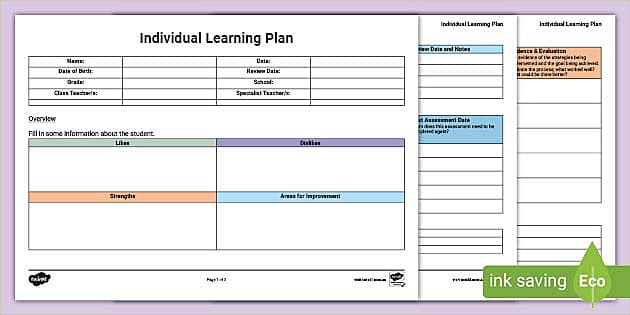
In the perfect world, each child would be able to have a learning plan where they individually have goals and tasks laid out for them that are tailored to their needs. However, this is not exactly easy to do with 30 individuals in a class. A lesson plan provides a much less individual experience for each student, meaning that the type of instruction may not work for every student, and instruction has to slow down to match the speed of the slowest students. Lesson plans are efficient for the teacher, saving time and energy, and have a very focused layout that is suited to the beginning of units where information is dense. However, Learning plans offer a much more flexible scenario for the students. They are focused on the student and allow for co-creation of success metrics, which leads to much more buy in from the students and a greater degree of investment. Learning plans are more effective for individual students, but a realistic classroom means that often, teachers would have to use lesson plans to augment learning plans. With sites like TeachersPayTeachers or Twinkl learning plans are becoming much more accessible, and including AI in a teachers toolkit means that learning plans will take up less time for the teacher. Below is a picture of a premade learning plan sheet on Twinkl, free for use.