Our tech presentation topic is: how do we use the current generation’s interest in online games and spaces to increase attention and participation in the classroom. Here is our video presentation on our findings:
Topic 7 – Free Inquiry Blog Post
This week was another incremental step in my inquiry into climbing performance and strength training. This week there was no breakthroughs, however I worked quite hard at a V5 boulder and saw some noticeable changes in my endurance.
Climbing Progress
I completed two sessions of climbing this past week, both were bouldering sessions. They followed the regular pattern of Tuesday-Thursday, however I climbed at a different gym on Tuesday than I normally do, and so the grading was a bit off. I was able to climb at my baseline, but I noticed that I was able to do a 2 hour session quite easily this time, rather than the usual 1.5 hours. I made some more progress on V5 boulders, but have yet to complete one.
After noticing my poor technique last week, I decided to work on a specific boulder that worked on my footwork, this is letting me practice my weaker areas specifically, and should hopefully improve my overall performance.
The gym I went to this Tuesday is called Boulderhouse. It is a bouldering only gym where several world class athletes climb regularly.
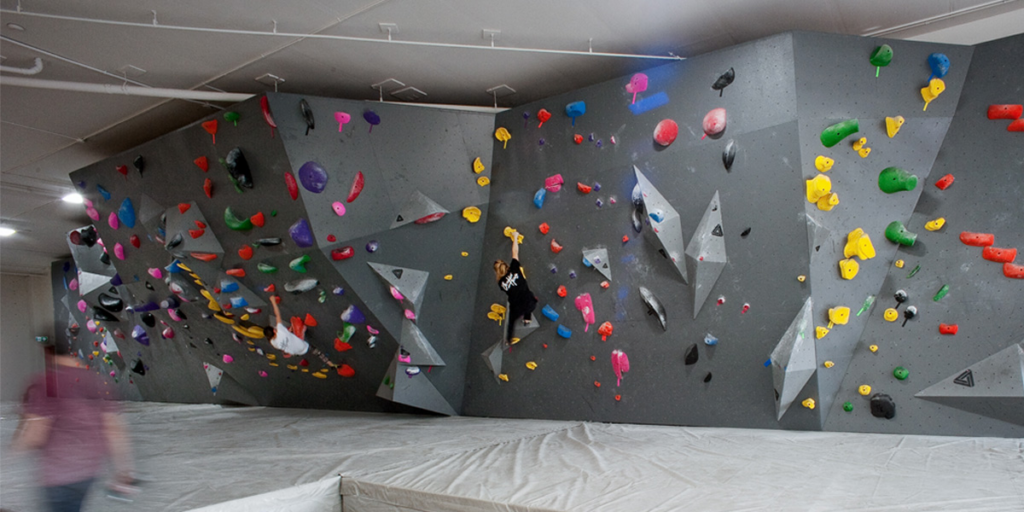
PC: Boulderhouse.ca
Strength Training
This week I was only able to complete 1 session of strength training rather than the 2 I had set out as my goal.
My program was:
- Squat: 10×3 – 165lbs
- Bench Press: 8×4 – 120lbs
- Deadlift: 5×6 – 265lbs
I saw a steady increase over my last week’s training program even though I only went once this week, which was good to see, but I need to hold myself more accountable to missing the programs. My finger issues have slightly been fixed, but I believe that this is more likely due to the time off during reading break.
All my lifts were fine, and I think that my progress is okay, but could still be more on track. Next week I will focus on getting myself out there twice instead of once.
Reflection
This week the thing to work on is consistency, I need to hold myself accountable to going as many times as I said I would. Climbing is not an issue on this front, but for the strength training it really will make a difference.
Topic 7 – Weekly Reflection Blog Post
Today’s blog post will be focused around accessibility online. Accessibility in this case includes video/photo descriptions in metadata, headings, and reflecting on accessibility practices.
Photo!

Featuring: Goober The Cat (centre) Photo Credits: myself
Reflection
For this weeks reflection I will be answering the following prompts:
- Are there any digital accessibility practices that you often see being missed? Are there any that you know YOU often miss?
- Are there any digital accessibility practises that surprised you? Why?
Are there any digital accessibility practices that you often see being missed? Are there any that you know YOU often miss?
The largest practice that I see being missed is that often websites lack colorblind sensitive colour palates. The poor contrast is something that is not usually paid attention to, especially in a world right now where a few seconds of looking at a website can make someone click away or stay. People often create websites that are designed to be as eye grabbing for the regular user as possible without caring about the exceptions. My digital footprint is about as limited as it can be, and so the digital accessibility practices that I have had a chance to actually use are limited to creating powerpoints or silideshows that come with a written document explaining everything on the slides. I personally know that I have missed changing documents to have proper formatting, as I did not know that Ereaders couldn’t distinguish between bolded text and regular text.
Are there any digital accessibility practises that surprised you? Why?
As I mentioned in the last answer, I was unaware that Ereaders could not distinguish between regular and bolded text, or different fonts. This was something that I assumed we had the technology for. I did not consider that the metadata of what actually is a heading and what is just bolded was as big of a deal as it is. Additionally I had not really considered the struggles that people who do not have the use of both hands would face when trying to utilize the internet or any digital tools. It just took me by surprise as it was something that I had never truly thought about.
Topic 4 – Weekly Reflection Blog Post
This week on our blog we have been asked to reflect on AI, it’s pros and cons, and uses in the classroom. Generative AI (GenAI) is mainly comprised of Large Language Models, which take mass amounts of text as it’s training data and produces what is effectively extremely advanced “auto complete.” Some GenAI tools have gone further and are able to produce image or video, however in this post I will be focusing on Today I will be addressing the prompts: What are some of the major limitations of GenAI? and Talk about how you’ve found GenAI useful or not for educational purposes.
What are some of the major limitations of GenAI?
GenAI is one of the major revolutions of our time, along with the communications revolution of the 2010s, it may be the most disruptive outcome of technology to everyday life. Since the beginning of its widespread use in 2021, the use of AI in everything from education to art has been utterly transformative for society writ large, specifically widely publicly available models such as ChatGPT or Gemini. The limitations of GenAI are clear, tools that seem intelligent offer students another way to find information, but the information that they receive can sometimes be wrong. Hallucinations, oversimplification, and questions of accuracy are all huge limitations to GenAI. There is major risk for students of becoming overly reliant on AI and then having it give you information that is simply false. Additionally, students may outsource much more of their thinking to GenAI. With something so easy and quick, it is more of a draw than ever to simply get AI to do your assignment for you, or tell you how to do it instead of doing it yourself. As a result, student’s abilities to evaluate information, construct effective arguments, or even fundamentally reason can be shaken or destroyed before they get a chance to grow. Lastly, the ethical implications are a huge limitation on GenAI. Environmental costs are real, and the ownership of ideas legally can become a huge problem for people who are using AI creatively. Additionally, this does not address where the training data for the AI came from, and whether or not it was available to the public.
The following are videos that I believe are relevant to this topic but are quite long.
My Experience Using GenAI for Educational Purposes
Here, I have to flip the script. As much as I harp on GenAI, and have legitimate grievances with it, I have also used it in my education so far, and plan to use it again while teaching. I have used GenAI to help me correct grammar, spelling, and punctuation, as I am often not the best when it comes to this kind of type editing. GenAI in my education has been much like a fancy word processor, while I use it to quickly help me format or edit my work, I refuse to turn to GenAI instead of thinking of my own ideas. For this assignment even, I have used it to help me format, giving it my ideas and getting it to suggest where in the blog post I should put things. But, I also only use its suggestions a fraction of the time as having it around helps me to be more confident in my own work, in comparison.
In the classroom I believe that I can take this a step further, AI is a fantastic tool and I believe that using AI to make some of the menial tasks of teaching is not just a benefit, but necessary to keep up with increased workloads. Teaching has long since been a job where you are expected to work hours well above the 40 per week that is allotted to you for pay. I am firmly against AI teaching students, but if there is any moral use for it, I think that using it to enhance student learning by allowing teachers to create quick, individualized, and effective assessments is as close as we can get.
h5p test post
Some text
Topic 2 – Weekly Reflection Blog Post
For our first blog post we have been asked to discuss a number of topics. Among these topics are: do we need to reimagine education? What are the potential benefits of developing a robust PLN? and Pros & cons of Lesson Plans vs Learning Plans. In this post I will go over my opinions on each of these three topics.
Do we need to reimagine education?
As it currently exists, the education system in BC caters broadly to the university system that exists after students graduate. Schools like those featured in the video “Most Likely to Succeed” or the Pacific School for Innovation and Inquiry offer a re imagined school, where student inquiry is the focus. For grades 10-12 the provincial public school system is the university system-lite, and so change in education would not be practical on the provincial level. It is unrealistic to imagine that universities across the world will change, and so changing the high school system too dramatically would be setting students up for failure at university. However, if there was large scale change in universities, systems like that from the Pacific School for Innovation and Inquiry may be more effective.
A discussion I had with two of my close friends who went to PSII reveals to me that inquiry led schools are not for everyone. For them, they put in significant amounts of work, often more so than other students did at public or more traditional private schools and so, for these students the school was a fantastic opportunity allowing them to go above and beyond the curriculum and to discover their passions. However, for others, it was simply a place they had to be for 8 hours a day, and a place to socialize. These students, who were not as driven, simply floundered academically, and got no real benefit from the alternative schooling system. So overall, I do not believe that these schools should replace the public system, but a reimagined school system may include elements, or streams, that incorporate many of the ideas from PSII and other inquiry based schools.
What are the potential benefits of developing a robust PLN?
A PLN, or Professional Learning Network, is a network of people that share information and teaching tools and resources with each other. Developing a robust PLN can mean that when you respond to a call out as a TTOC, you are equipped with tools that you would not have otherwise had for subjects that you may not be proficient in. Additionally, having a good PLN means that teachers have much more variety in the teaching tools that are available to them, meaning that they are able to meet the needs of a much more diverse audience of students.
Pros & Cons of Lesson Plans vs Learning Plans
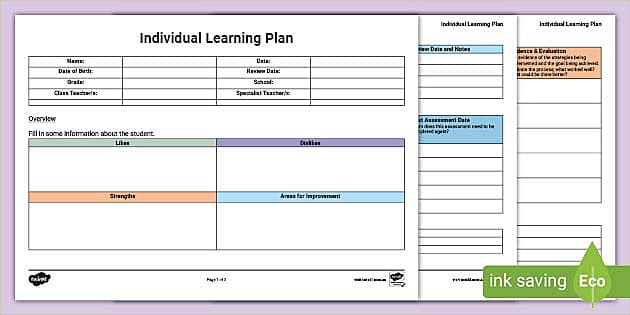
In the perfect world, each child would be able to have a learning plan where they individually have goals and tasks laid out for them that are tailored to their needs. However, this is not exactly easy to do with 30 individuals in a class. A lesson plan provides a much less individual experience for each student, meaning that the type of instruction may not work for every student, and instruction has to slow down to match the speed of the slowest students. Lesson plans are efficient for the teacher, saving time and energy, and have a very focused layout that is suited to the beginning of units where information is dense. However, Learning plans offer a much more flexible scenario for the students. They are focused on the student and allow for co-creation of success metrics, which leads to much more buy in from the students and a greater degree of investment. Learning plans are more effective for individual students, but a realistic classroom means that often, teachers would have to use lesson plans to augment learning plans. With sites like TeachersPayTeachers or Twinkl learning plans are becoming much more accessible, and including AI in a teachers toolkit means that learning plans will take up less time for the teacher. Below is a picture of a premade learning plan sheet on Twinkl, free for use.